
Top Indian Suit Styles for Broad Shoulders and Fuller Busts: A Ready-to-Wear Fit Guide
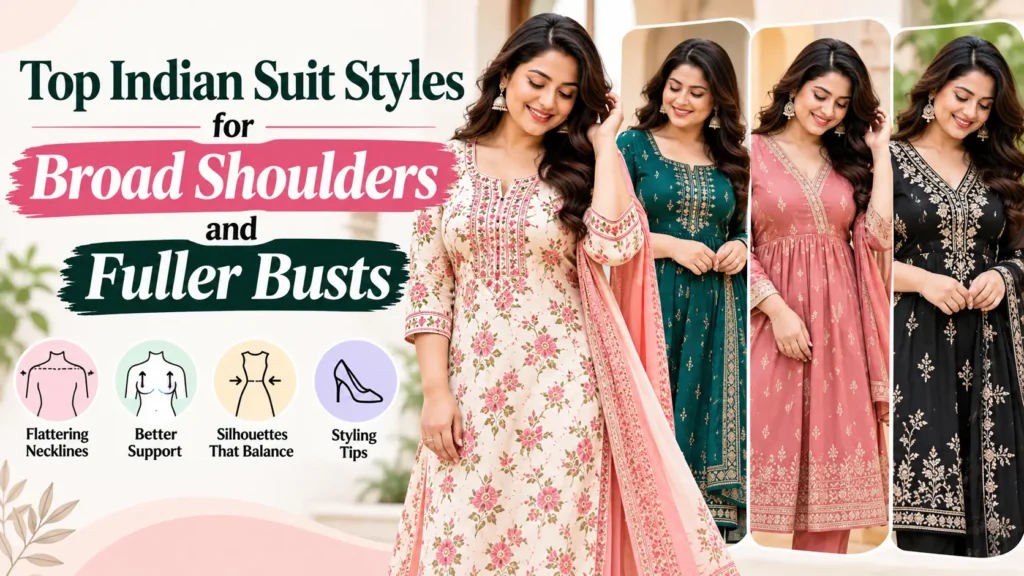
When a Beautiful Suit Doesn’t Fit the Way You Expected
Have you ever fallen in love with an Indian suit online, ordered your usual size, and then discovered that it fits perfectly everywhere except across your bust or shoulders?
Perhaps the buttons pull when you move. Maybe the armholes feel tight, the sleeves restrict your arms, or the dupatta never seems to sit comfortably over your chest.
And the frustrating part? Going up one size might solve the bust problem but leave the rest of the kurta looking much looser than you wanted.
If this sounds familiar, you’re not alone.
Shopping for ready-to-wear Indian suits can be challenging when your bust, shoulders, waist and hips don’t fit neatly into one standard size chart. But that doesn’t mean you need to get every outfit custom-stitched or give up on the designs you love.
The secret is understanding how different suit styles are constructed and knowing what to check before you buy.
Whether you love classic straight-cut kurtas, elegant Anarkalis, embroidered festive suits or everyday cotton salwar sets, there are plenty of styles worth exploring.
In this guide, we’ll look at necklines, kurta silhouettes, sleeve styles, dupatta draping and practical fitting tips to help you choose Indian suits that feel comfortable and reflect your personal style.
Quick Guide: Which Indian Suit Styles Should You Explore?
| Suit style or feature | What to look for | Why it may suit your preferences |
|---|---|---|
| Straight-cut kurta | Adequate room through the bust and hips | A clean, versatile silhouette |
| A-line kurta | Comfortable upper-body fit with gradual flare | More room towards the hem |
| Angrakha-style kurta | Secure wrap construction and comfortable bust fit | Adds traditional detail and visual interest |
| Anarkali suit | Suitable bodice fit and comfortable skirt volume | Offers a flowing, occasion-ready look |
| V-neck or split neckline | A depth and width you find comfortable | Creates an open neckline |
| Three-quarter sleeves | Comfortable upper-arm circumference | A versatile option for everyday and festive wear |
| Lightweight dupatta | A fabric that drapes comfortably | Offers multiple styling possibilities |
These are options to explore, not rules for particular body shapes. The right choice depends on your measurements, preferred coverage, garment construction and the look you want.
1. Straight-Cut Suits: A Versatile Choice for Everyday Wear
Straight-cut kurtas are a wardrobe staple for a reason. They work for everyday errands, office wear, family gatherings and more polished occasions, depending on their fabric and detailing.
The silhouette generally falls relatively straight from the upper body towards the hem. However, the fit can vary considerably between brands.
For women with fuller busts or broader shoulders, the important thing is to find a straight-cut kurta that provides enough room where it is needed.
What should you check?
The shoulder fit
The shoulder seams should sit comfortably, without digging into your shoulders or falling too far down your arms unless the garment is intentionally designed with dropped shoulders.
The bust area
Look for enough room to move comfortably. If the fabric pulls across your chest or the buttons gape, the kurta may not have sufficient bust ease.
The hip area
A straight-cut kurta should not restrict your movement. Check the hip measurement, side slits and hem circumference, particularly if you have fuller hips as well.
How to style a straight-cut suit
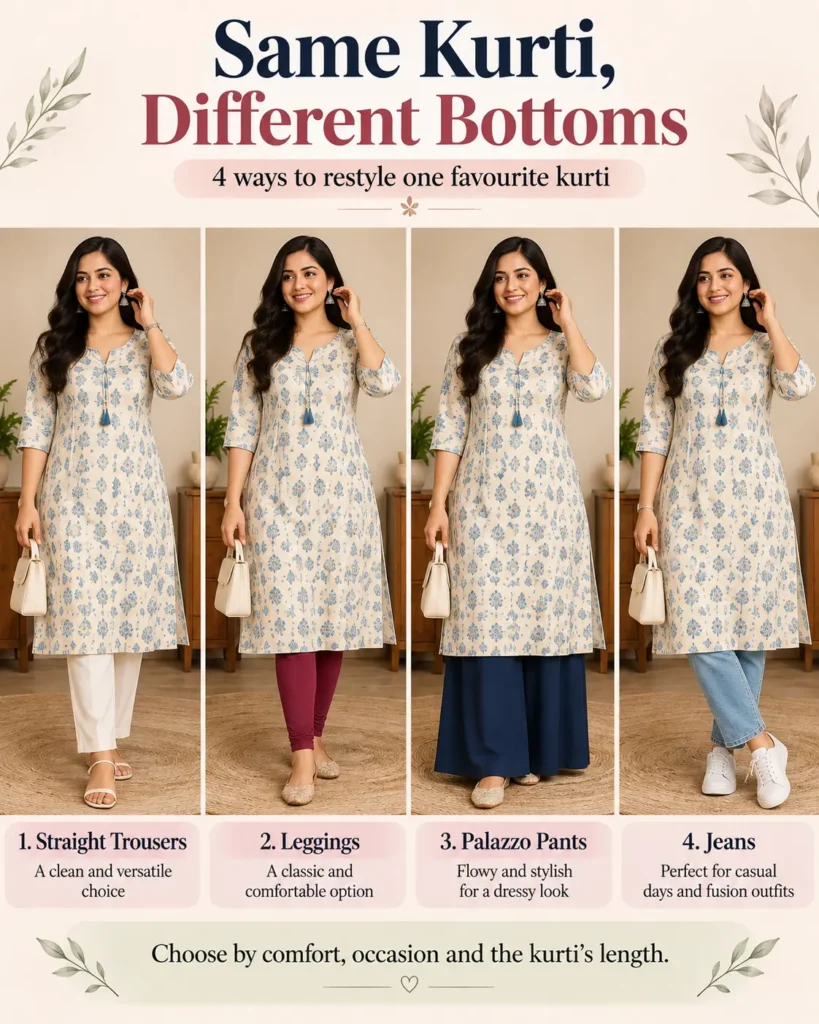
For everyday wear, try a printed cotton kurta with straight trousers, comfortable sandals and small earrings.
For the office, choose a solid-coloured or subtly printed kurta with coordinated pants, a watch and a structured handbag.
For a family gathering, add a lightweight dupatta and statement earrings to the same basic silhouette.
Styling tip: Don’t assume a straight-cut kurta must fit tightly to look structured. A comfortable fit with clean lines can look just as polished.
2. A-Line Suits: Room to Move Without Excessive Flare
An A-line kurta generally fits through the upper body and gradually widens towards the hem.
This style is worth exploring if you prefer additional room around the waist and hips while keeping the upper part of the outfit relatively structured.
But here’s something important: an A-line cut does not automatically solve a fuller-bust fitting problem.
If the garment is too small across the chest, the flare cannot compensate for the lack of room at the bust.
How to choose a ready-to-wear A-line kurta
Start by checking the shoulder and bust measurements. Then look at where the flare begins.
Some A-line kurtas widen gently from the waist, while others flare from higher up. The placement changes the garment’s shape and how much room it provides.
If you have a fuller bust, make sure the front panel lies comfortably and that any seams or decorative details do not pull or distort.
Outfit ideas
- Everyday: Cotton A-line kurta, straight trousers and flat sandals.
- Office: Solid-coloured A-line kurta, coordinated pants and minimal jewellery.
- Festive: Embroidered A-line suit, matching bottoms and a lightweight dupatta.
Choose the version that suits your preferred silhouette and feels comfortable throughout the day.
3. Angrakha-Style Suits: Traditional Details With a Modern Feel
Angrakha-inspired kurtas feature overlapping panels, wrap-style lines or tie details.
They can add visual interest to your outfit without requiring heavy embroidery or elaborate accessories.
However, wrap-style designs need particular attention when you have a fuller bust.
What to look for
Check whether the overlapping panels provide adequate coverage and whether the ties or fastenings hold the garment securely in place.
If the fabric separates when you move, the neckline opens too far, or the ties pull across the bust, the garment may need a different size or construction.
Also examine the shoulder seams and armholes. A comfortable wrap front will not compensate for restrictive sleeves.
How to style an Angrakha suit
For casual wear, try a printed Angrakha kurta with solid straight trousers and simple earrings.
For festive occasions, choose a version with embroidery or a coordinated dupatta.
If you prefer additional neckline coverage, look for a design with a secure overlap or consider whether a suitable camisole can be worn underneath.
My advice: Pay attention to how the wrap closes, not just how attractive the neckline looks in the product photograph.
4. Anarkali Suits: Elegant Options for Festive Occasions
Anarkali suits are known for their flared silhouettes and flowing skirts. Depending on the design, they can be appropriate for weddings, festive celebrations, family functions and other special occasions.
A fuller bust does not mean you need to avoid Anarkalis. The key is to choose a bodice that fits properly and a level of flare that you enjoy wearing.
How to find a comfortable Anarkali
Check the bodice first. The bust measurement, shoulder fit, armholes and any waist seam should all allow comfortable movement.
Next, consider where the flare begins. An empire-style seam below the bust creates a different silhouette from a more fitted bodice with flare beginning at the waist.
Neither is universally better. Choose according to your preferred design and how the garment sits on your body.
Finally, consider the fabric and lining. Multiple layers, heavy embroidery and stiff materials can make a suit feel substantially heavier than a lightweight cotton or fluid fabric.
Styling an Anarkali suit
For a daytime celebration, choose a lightweight Anarkali with understated earrings and comfortable flats.
For a wedding guest outfit, explore embroidered fabrics, coordinated bottoms and traditional jewellery.
If the suit has substantial flare or detailed embellishment, keep your accessories coordinated rather than feeling you must add decoration everywhere.
A well-fitted bodice and comfortable movement matter far more than choosing a particular silhouette because someone says it is mandatory for your body shape.
5. Which Necklines Should You Consider?
Necklines can change the character of a kurta significantly. They also affect neckline coverage, bra compatibility and how comfortable you feel throughout the day.
There is no single neckline that every woman with a fuller bust or broad shoulders should wear. Instead, compare the options and consider how each works with the garment’s construction.
V-neck
A V-neck creates an open, angled neckline. Some women enjoy the way it introduces a vertical line to the outfit.
Check the depth and width to ensure you have the coverage and support you prefer.
Scoop neck
A scoop neckline has a rounded shape and comes in different depths.
It can be a comfortable everyday option when the neckline sits securely and works with your preferred undergarments.
Square neck
Square necklines create a defined, structured appearance. They are worth trying if you like contemporary ethnic styling.
Check the neckline width, shoulder fit and whether the edges lie flat rather than pulling.
Notched or split neck
A notched neckline introduces a small opening at the centre front. It offers a little visual detail without requiring a deep neckline.
It can work well on everyday kurtas and office-wear suits.
Round neck
Round necklines remain a classic choice for Indian wear. A round neckline can be narrow, wide, shallow or deep, so the exact construction matters.
If you have a fuller bust, examine the front opening and ensure the garment provides enough room without pulling at the neckline.
The takeaway: Choose your neckline based on comfort, coverage, garment fit and personal preference—not a rule that says a particular body shape must wear a particular cut.
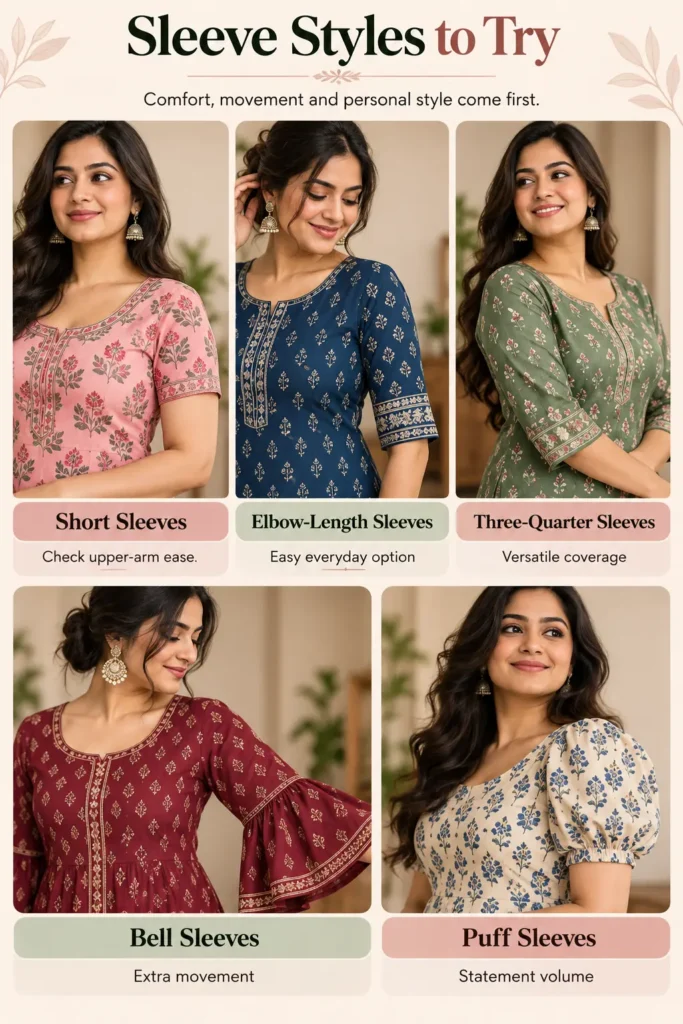
6. Sleeve Styles for Broad Shoulders and Fuller Upper Arms
Sleeves influence the comfort and overall appearance of an Indian suit. When shopping online, sleeve measurements are especially useful because a kurta may fit the bust but feel tight around the upper arms.
Here are several options worth comparing.
| Sleeve style | What to consider |
|---|---|
| Short sleeves | Check the sleeve opening and upper-arm circumference |
| Elbow-length sleeves | A practical option if you prefer moderate arm coverage |
| Three-quarter sleeves | Versatile for everyday, office and festive suits |
| Bell sleeves | Add movement and decorative volume |
| Puff sleeves | Create a more pronounced statement around the shoulders |
| Raglan sleeves | May offer a different shoulder and armhole construction |
| Dropped-shoulder sleeves | Offer a relaxed look, depending on the garment’s cut |
How to choose the right sleeve fit
If your sleeves feel tight, check the upper-arm circumference rather than automatically increasing the entire garment size.
Look at the armhole construction too. A small armhole can restrict movement even when the sleeve itself appears roomy.
If you prefer a more structured outfit, try a sleeve with a clean finish and enough room for movement. If you love statement sleeves, experiment with bell or puff styles.
Broad shoulders do not mean you must avoid decorative sleeves. Choose them because you enjoy the look, and make sure the garment feels comfortable.
7. How to Drape a Dupatta When You Have a Fuller Bust
The dupatta can completely change the appearance and practicality of an Indian suit. It can add colour, texture and elegance, but it should not become something you have to adjust every few minutes.
The goal is to find a drape that feels secure and works with your outfit.
Style 1: One-shoulder drape
Place the dupatta over one shoulder and allow it to fall naturally.
This is a simple option for everyday suits and coordinated sets. Secure it with a pin if needed, ensuring the pin does not damage delicate fabric.
Style 2: Two-shoulder drape
Place the dupatta over both shoulders, allowing it to fall down the front.
This can work well when you want a more traditional appearance or additional coverage.
Check that the fabric does not pull across the chest and that you can move your arms comfortably.
Style 3: One shoulder with a front fall
Drape the dupatta over one shoulder, allowing one end to fall towards the front.
This gives the outfit a traditional look without requiring complicated pleating.
Style 4: Lightweight dupatta with a secure shoulder pin
If you find your dupatta slipping throughout the day, try a lighter fabric and secure it discreetly at the shoulder.
The fabric’s weight, texture and finish affect how well it stays in place.
Style 5: A neatly pleated shoulder drape
Pleat the dupatta neatly over one shoulder and secure it with a pin.
This can be a practical choice for occasions when you want a tidy, coordinated appearance.
Style 6: Side drape
Place the dupatta over one shoulder and let it fall more towards the side rather than arranging most of the fabric across the front.
This is worth exploring if you prefer a less layered appearance.
One important point: You do not need to use a dupatta to conceal your bust. Choose a drape that suits your outfit, coverage preferences and comfort.
8. Fabric and Construction: What Matters More Than the Size Label
Two kurtas in the same size can fit very differently because their fabric, construction and ease are not identical.
When shopping for ready-to-wear Indian suits, pay attention to these details.
Cotton
Cotton suits can be useful for everyday wear. Depending on the weave and finish, the material may be crisp, structured or soft.
Check whether the fabric is lined, whether it is transparent and how it is expected to behave after washing.
Rayon and viscose
These fabrics often offer a fluid drape, although the exact feel varies by composition and construction.
Check whether the garment has enough room through the bust and whether the material clings or moves in the way you prefer.
Crepe and other fluid fabrics
Some crepe fabrics create a relatively smooth, flowing appearance. Others are lightweight or require lining.
Read the product details rather than assuming every fabric sold under the same name behaves identically.
Stiffer fabrics and heavily embroidered suits
Structured fabrics and substantial embroidery can create a more defined silhouette, but they may also affect comfort and weight.
For a fuller bust, check that decorative seams, closures and lining do not pull across the chest.
Garment ease: the detail many shoppers overlook
Garment ease is the difference between your body measurement and the finished garment measurement.
For example, if your bust measures 100 cm and a kurta’s finished bust circumference measures 108 cm, the garment has 8 cm of positive ease at the bust.
That does not automatically mean the fit is ideal. The required ease depends on the fabric, cut, construction and intended silhouette.
The practical lesson is simple: compare finished garment measurements where available, not just your body measurements or the size printed on the label.
9. How to Choose a Ready-to-Wear Suit When Your Bust and Shoulders Need More Room
This is one of the most useful skills you can develop when shopping for Indian ethnic wear.
Suppose your bust fits one size, but the shoulders or upper arms feel tight. Increasing the size might give you more room across the chest, but it could also make the neckline, shoulders or waist too loose.
Instead of automatically sizing up or down, use this approach.
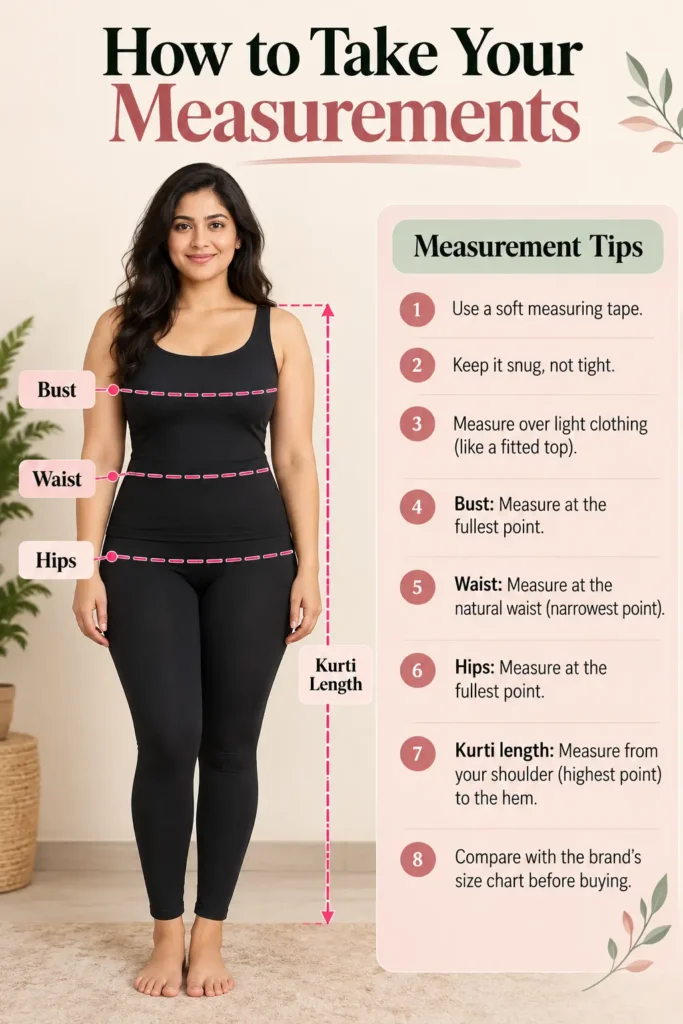
Step 1: Measure yourself accurately
Measure your bust at its fullest point, your waist at its natural narrowest point if applicable, your hips at their fullest point, and your upper arm where you need sleeve room.
For shoulder fit, follow the brand’s measurement instructions. Some brands provide shoulder width; others do not.
Wear a well-fitting bra that you would normally wear with the outfit, and use a soft measuring tape without pulling it tightly.
Step 2: Compare the garment measurements
Look for the finished bust, shoulder, waist, hip and sleeve measurements when available.
If a listing provides only body measurements, follow that brand’s size-chart instructions and do not assume those numbers represent the actual garment dimensions.
Step 3: Identify the area causing the problem
If the bust is tight but the shoulders fit, you may need a different cut or a size that provides more bust room.
If the bust fits but the upper arms are restricted, check the sleeve circumference and armhole.
If the shoulders fit but the waist is loose, a different silhouette or a feasible alteration may be more practical than choosing a smaller size that compromises the bust fit.
Step 4: Decide whether an alteration is worthwhile
Small adjustments may improve the fit of some garments, but not every kurta can be altered successfully.
Check the available seam allowance, lining, embroidery placement, side slits and garment construction before deciding.
If alterations are expensive or the garment needs several major changes, choosing a better-fitting design may be the more sensible option.
10. Five Complete Indian Suit Outfit Ideas
Let’s turn the advice into looks you can recreate.
Look 1: Everyday cotton suit
- Printed cotton straight-cut kurta
- Solid straight trousers
- Flat sandals
- Small earrings
- Lightweight dupatta
Choose a kurta with comfortable bust and sleeve measurements. This combination works well for errands, casual outings and relaxed daytime activities.
Look 2: Polished office wear
- Solid-coloured or subtly printed kurta
- Coordinated straight trousers
- Loafers or comfortable closed-toe flats
- A watch and simple earrings
- Structured handbag
Pay attention to the shoulder fit and whether the neckline feels appropriate for your workplace.
Look 3: Casual family gathering
- A-line kurta
- Coordinated pants
- Lightweight dupatta
- Statement earrings
- Comfortable sandals
If the kurta has a print or decorative neckline, let those details guide your accessories.
Look 4: Festive celebration
- Embroidered Angrakha or Anarkali suit
- Coordinated bottoms
- Traditional earrings and bangles
- Embellished flats
- Small clutch
Check the bodice, neckline closure and fabric weight before purchasing. A beautiful festive suit should still allow you to sit, walk and enjoy the occasion comfortably.
Look 5: Modern Indo-Western styling
- A well-fitting short or medium-length kurta
- Straight trousers or jeans
- Comfortable sneakers or sandals
- A crossbody bag
- Minimal jewellery
This is a practical way to combine Indian wear with contemporary pieces for casual outings or everyday life abroad.
11. Your Ready-to-Wear Indian Suit Decision Tool
Before you buy, identify your biggest fitting concern and use the following table to narrow down your options.
| Your main concern | What to check first | Styles worth comparing |
|---|---|---|
| Tightness across the bust | Finished bust measurement, darts and button placement | Straight-cut or A-line kurtas with adequate room |
| Tight shoulders | Shoulder width and seam placement | Different shoulder constructions and cuts |
| Tight upper arms | Sleeve circumference and armhole | Three-quarter, elbow-length or roomier sleeves |
| Pulling across the waist or hips | Finished waist and hip measurements | A-line, gently flared or appropriately sized straight-cut kurtas |
| Dupatta slipping or shifting | Fabric weight, texture and pin placement | Lightweight dupattas and secure shoulder drapes |
| A festive outfit that feels too heavy | Fabric weight, lining and embroidery | Lighter Anarkalis or less heavily embellished suits |
Use this simple three-question test
Question 1: Does the suit fit comfortably across the bust and shoulders?
If not, check the relevant measurements and garment construction before considering the design.
Question 2: Can I sit, walk and move my arms without the fabric pulling?
If not, look at the armholes, sleeves, side slits and overall ease.
Question 3: Can I wear it confidently with the bottoms, dupatta and footwear I already own?
If yes, you have a more practical purchase than one that looks beautiful in a product photo but is difficult to style or wear.
12. Common Shopping Mistakes to Avoid
Buying only by the size label: Different brands use different sizing systems. Compare the relevant measurements.
Assuming a bigger size always solves a fuller-bust problem: It may create extra room in the wrong places. Compare cuts and construction too.
Ignoring the armhole: A roomy sleeve cannot compensate for an armhole that restricts movement.
Choosing a neckline only because it is trending: Consider coverage, support, comfort and the way the neckline lies on your body.
Assuming a dupatta must cover the chest: Use the drape you prefer. It is an accessory, not an obligation to conceal a body part.
Treating body-shape advice as a strict rulebook: Your proportions can help guide shopping decisions, but they should never dictate which clothes you are allowed to wear.
Final Thoughts:
If shopping for Indian suits has ever left you frustrated because the bust fits but the shoulders don’t—or the shoulders fit but the sleeves feel tight—I want you to approach your next purchase differently.
Start with your measurements. Understand how the garment is constructed. Compare the fit across your bust, shoulders, arms and hips. Then choose a silhouette, neckline and dupatta style that reflects your taste.
You can wear straight-cut kurtas, A-line suits, Angarkha designs and Anarkalis. You can experiment with different necklines and sleeves. You can choose a traditional look, a modern fusion outfit or something in between.
You don’t have to dress according to a rigid set of body-shape rules.
The best Indian suit is one that fits your body comfortably, works for your life and makes you feel like yourself.
Explore More on LookSaheli
- Best Kurti Styles for Petite Curvy Frames: Flattering Off-the-Rack Looks
- What Is the Best Kurti Length for a 5-Foot Woman?
- How to Choose the Right Kurti Size When Your Bust and Hips Need Different Sizes
- How to Choose a Saree and Blouse for a Fuller Bust and Thick Waist
Frequently Asked Questions
Which Indian suit is best for a fuller bust?
Straight-cut, A-line, Angrakha-style and Anarkali suits can all work. Prioritize sufficient bust ease, comfortable shoulders, suitable armholes and a neckline that feels secure.
Which neckline is best for broad shoulders?
V-necks, scoop necks, square necks, round necks and notched necklines are all worth exploring. The result depends on the neckline’s dimensions, shoulder construction and the overall design. There is no single universally best neckline.
Should women with broad shoulders avoid puff sleeves?
No. Puff sleeves are a style choice, not something you must avoid because of your shoulders. If you enjoy the look, check the sleeve volume and how it interacts with the garment’s shoulder construction.
Can I wear an Anarkali if I have a fuller bust?
Absolutely. Check the bodice, bust ease, shoulder fit and waist-seam placement. Also consider the fabric weight and amount of flare to ensure the garment feels comfortable.
How can I stop my dupatta from slipping?
Try a lighter fabric, a neatly arranged shoulder drape or a discreet pin. The best method depends on the fabric, outfit and the level of movement required.